‘Tis the Gimme Season

I am sure you thought the political gimme season was over.  

Not so.

Unfortunately, the gimme season is overlapping with the Yuletide giving season.

Not for profits (NFP) increase their requests for donations when it’s the giving season.

Whether it’s a political gimme or a not-for-profit do your own research.

If someone is after your money, they will have a website.


  • Where does the money come from—their donor base? This will be in the Notes section of the financial statements.

  • Where does the money go—what services is the promise that is stated to donors?

  • Compare the organization’s administration costs with what they really spend on the services they are supposed to provide. They shouldn’t be upside down … meaning that more goes to administrative related costs vs to actual service provided to their “cause.” Charity Navigator is a good resource.

  • Are there a lot of small accounts that could (and should) be in one account?

Take time to read the organization’s complete financial statements. Don’t stop with the balance sheet and the profit loss statement.  Take time to read the notes to the financial statements.

You will be amazed at how much information is in a complete set of financial statements.

   Patricia Lane Williams, CPA has worked with thousands of men and women sounding the warnings. She is the author of the Amazon bestseller, Money: Get It. Save It. Grow It … Before Debt Steals It. It’s her first book in the Four Corners Prosperity series. Her website is www.PatWilliamsAuthor.com.

Question do you need a bank account?

Did you answer no? The correct answer is yes. Most employers today make it possible to pay their employees by direct deposits. They make it possible to deposit your check in more than one account dividing it between such accounts as checking, savings, even a pension account. When an organization hires an employee, they have the new recruit fill out a form that says where they want all their money deposited.

At the same time, you may receive a card that you can use at any ATM. You will be asked if it is a credit card or debit card. Always say credit. Why?

Two reasons:

If you touch “debit” the money is immediately taken from your bank account.

If someone gets ahold of your card and you checked “debit” they may be able to clean out your account in seconds.

How familiar are you with banks? Do you have a checking account? How about a savings account?

Let’s take a hard look at banks. Most people are familiar with only two things that a bank does, checking accounts and savings accounts. Let’s start with those two and add:

·       Certificate of deposits

·       Money market accounts

·       Credit and debit cards

·       Auto loans

·       Mortgage loans

·       Student loans

·       Retirement accounts

·       Investment accounts

·       Insurance

·       Wealth management advice

·       ATMs

Visit your local bank. Get to know the people who work there. You’ll find that most people who work in banks are very helpful and they really believe in “customer service," at least the bank I use does.

LOWERING YOUR CREDIT CARD INTEREST RATE okay

If you have credit cards . . . with or without balances . . . Get them out and research  each card issuer and determine if there are any specials for new accounts -- the ones that offer reduced rates.

If you succeed than this is what I want you to do. Do not reduce your payments on an outstanding balance. Because the interest rate get hold of more moneys lower your minimum payment is reduced but ignore it. Always pay more than the minimum to reduce the balance.

GET HOLD OF MORE MONEY

Need more money? Here's a list of short term solutions. Sometimes referred to as ''side hustles.''


Sell stuff. Everyone has a lot of stuff just lying around the house collecting dust. Your stuff could be somebody else's treasure.


Sell at a flea market. Sometimes called swap meets you can find any number of flea markets by searching online.


Have a yard sale. No matter what you call them yard, tag, or garage sale once the stuff leaves the house it it never comes back. back.


Make stuff'. Are you a creative person? Like to work with your hands knitting, crocheting ,woodworking? I know one woman who does quite well by taking photographs and turning them into greeting cards and selling them on her own website. Search the web and you'll find many more groups willing to sell your stuff.


Get a part-time job. Part-time jobs have been known to lead to full-time jobs or a changes in careers.

Make it stand out

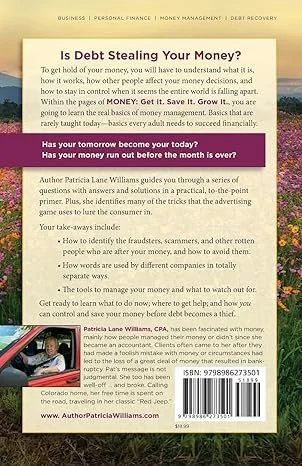
Is Debt Stealing Your Money?

To get hold of your money, you will have to understand what it is, how it works, how other people affect your money decisions, and how to stay in control when it seems the entire world is falling apart. Within the pages ofMONEY: Get It. Save It. Grow It., you are going to learn the real basics of money management. Basics that are rarely taught today—basics every adult needs to succeed financially.

Money Sucks and Time Wasters

You’ve heard the old saying “Time is money.” I can think of three things that are timewasters, at least for me. Shopping, technology and its cousin social media can waste a lot of time.

Probably the biggest waste of time is the tools, gadgets, apps, and games that are in social media.

Technology does have its good side. Technology can save a lot of time. Back in the day when I was a beginning accountant every thing was done on spread sheets which took a long time to generate. Columns pf figures had to be added (or subtracted) on an adding machine.

Today those spread sheets can be generated at the click of a button and the computer replaces the adding machine.

Today we can do things virtually, which save a lot of time.

Shopping used to require wandering around the store looking for what you needed or wanted. Today you can go on Amazon and find anything from coffee filters to today’s best seller and find it on your doorstep that afternoon.

When you determine what you want and the importance of getting to your goals, then you will be able to change how you control your time and money.

How do you feel about money?

How do you feel about money?

Money problems rarely bubble up overnight. One exception could be a medical crisis that suddenly evaporate savings and assets. What money problems do is creep… a little bit here, a little bit there and what seems like suddenly to you is a mountain of debt. Money problems usually come from a series of happenings, mistakes, lack of awareness of expenses versus income, lack of planning and, sometimes foolishness.